Two Miniature Schnauzers
with Struvite urinary stones - correct stone analysis is
important for prevention and treatment
Case
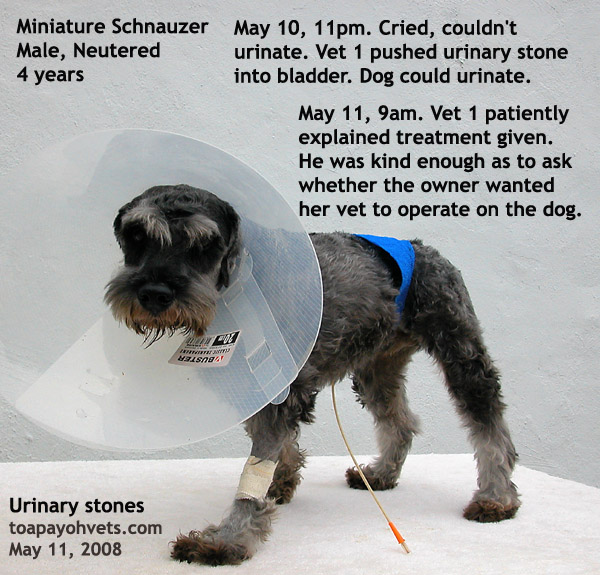
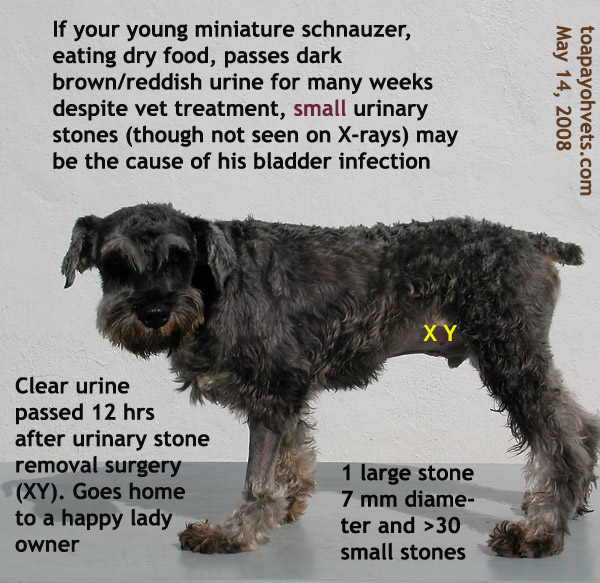
1: 2008 - Male, Neutered, 4 years old
No second chance for a Miniature Schnauzer
Follow up:
Recurrence 2 months later, due to lack of compliance with
prevention advices and check ups. Young lady owner requested
euthanasia
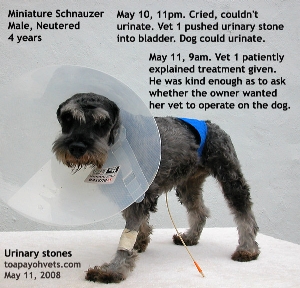 |
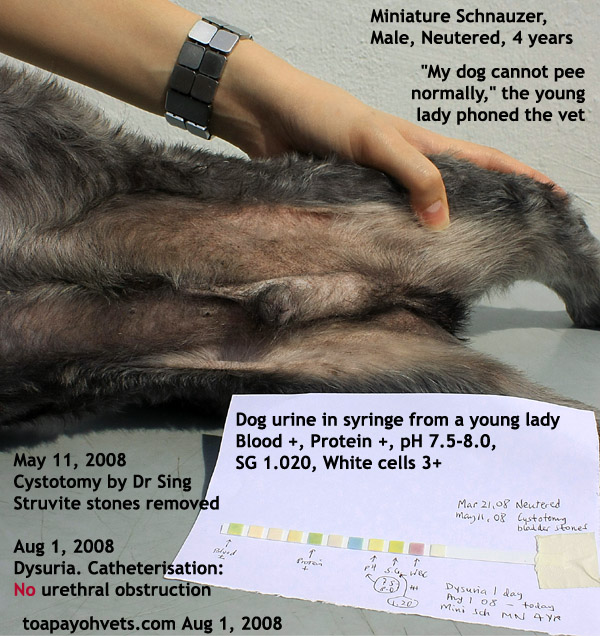
A urethral stone obstructed urine flow. Painful.
It was near midnight. The young lady consulted Vet 1.
Emergency treatment was given. The kind veterinarian
offered the young lady an option: "Do you want your
veterinary surgeon to operate your dog?" |
 |
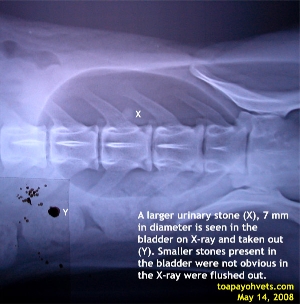 |
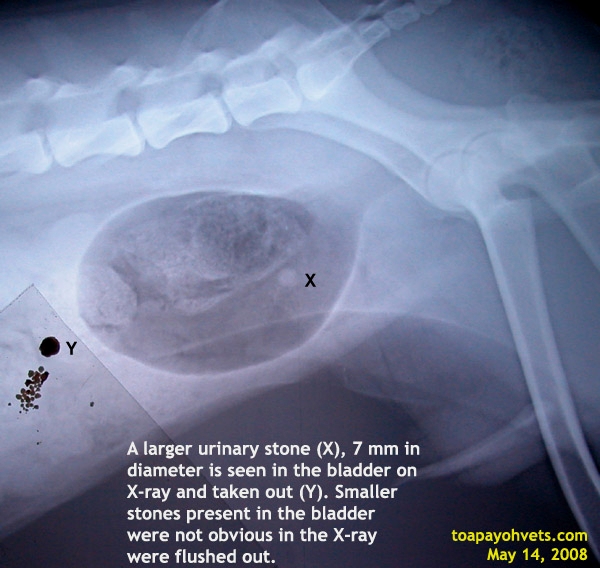
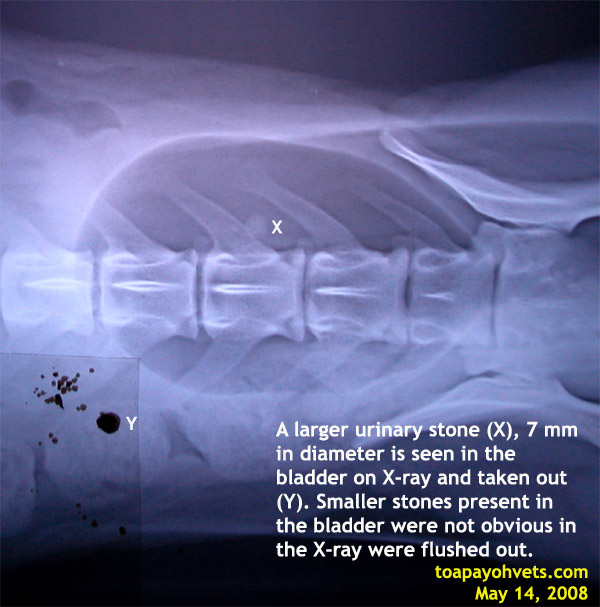
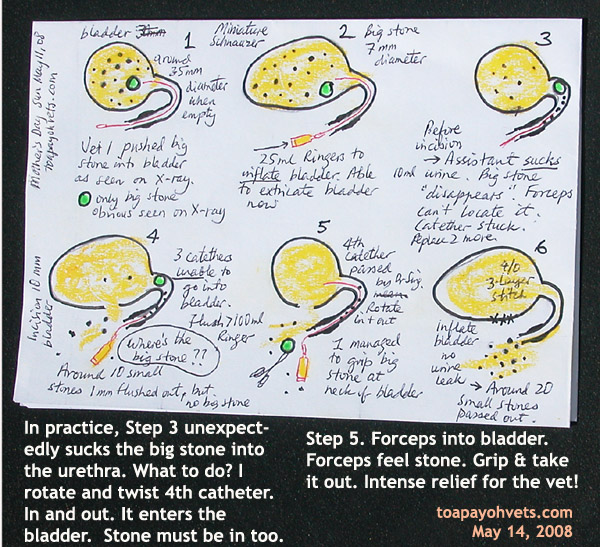
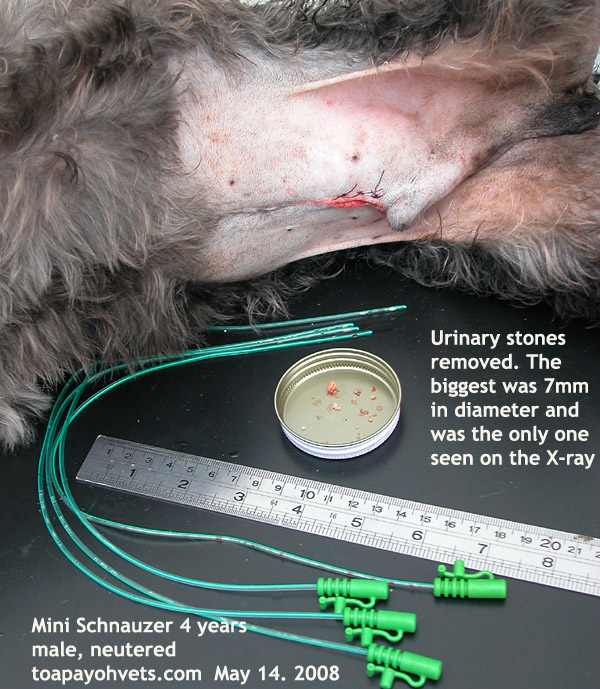
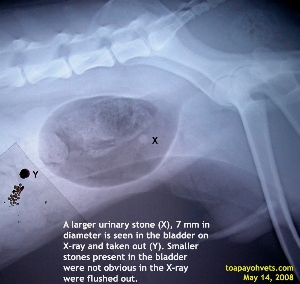
An excellent X-ray taken by Vet 1. Just one urinary
stone to take out? Under isoflurane gas
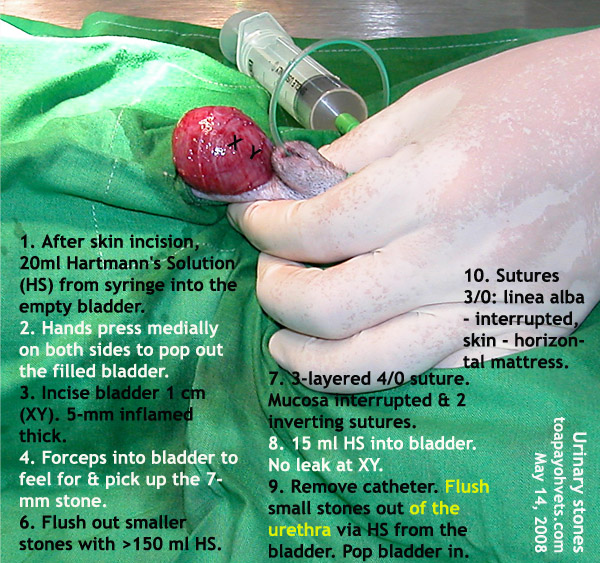
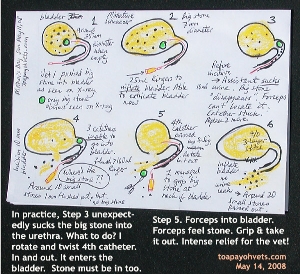
anaesthesia, I removed numerous smaller stones (see
actual stones on the lower left of the X-rays).
|
 |
 |
 |
|
Bladder is inflamed |
 |
 |
 |
|
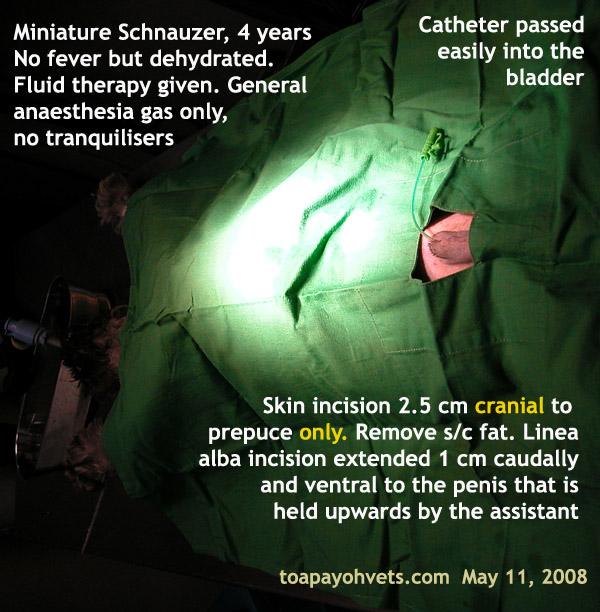
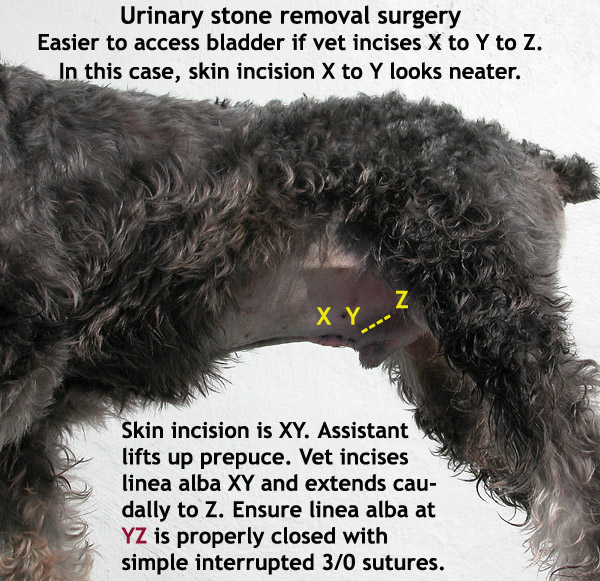
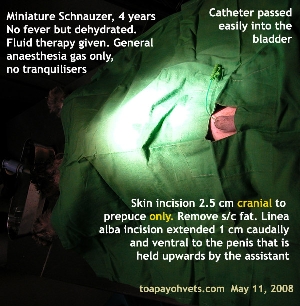
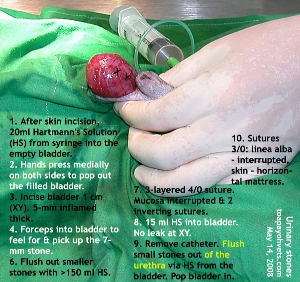
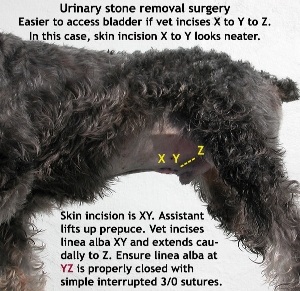
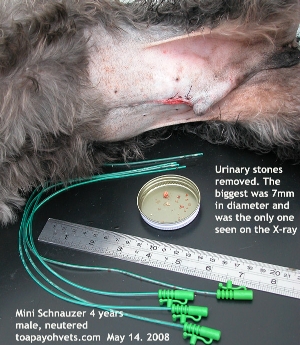
How to get the small empty bladder out? I made a
skin incision site (XY) that was not the traditional one
(YZ) mentioned in the some veterinary surgery
text-books. Each surgical approach has its pros and
cons. Dry food not to be taken. Follow-up monthly and
urine tests were advised. There was no news from the
owner. |
| |
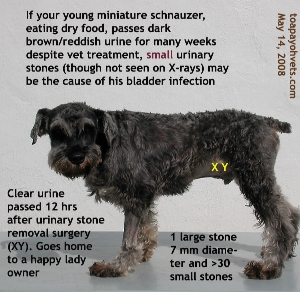
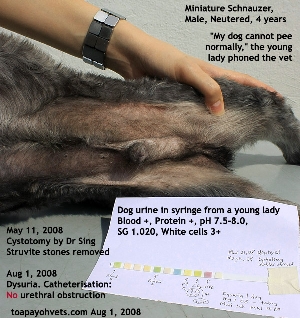
Two months after surgery, the Miniature Schnauzer
had difficulty in passing urine again. Struvite + on
urine microscopy by a laboratory. The owner did not want
any more treatment. In this recurrent case, medical
treatment using drugs to dissolve the small urinary
Struvite stones, acidify the urine and antibiotics would
give a higher chance of success. |
 |
For economic reasons, the young lady requested
euthanasia. There was no second chance for this
dog.
|
|
Case 2:
2010 - Female, Spayed, 5 years old
Struvite Stones in a Miniature Schnauzer?
E-MAIL
TO DR SING SUN JUL 11, 2010
On Sun, Jul 11, 2010 at 3:15 AM,
...@gmail.com> wrote:
Hi,
I found out about Toa Payoh vets as I was
browsing pet forums and blogs. I have a 5yr old female mini
schnauzer (high risk for stones). I adopted her from one of my
husband's friend's last year. She has been struggling with
Struvite stones ever since we adopted her. There was blood in
her urine last July/Aug. It subsided after a course of
antibiotics. The condition recurred again this year (June). I
reckon it was due to the new food supplement I gave her. I
have already consulted 2 vets, but they said surgery is main
cure. I was browsing your website and saw that you guide
owners who do not want surgery. I am interested in this
approach.
I hope to have a second opinion. I am
already cooking for my pet and she eating home cook food with
Urinary s/o and cranberry juice. I hope to do more for her to
ensure she has a better quality of life. Not sure if I can
bring my pet down this coming week (preferably Mon, Fri or Sat
mornings) for a consultation.
P.S
My pet is outside trained, and if she starts
peeing indoors for no reason, it means the stones are back.
She urinated at home again today, but not sure if it is due to
stones or the change in schedule since we brought her for
grooming and didn't bring her for her usual long walk due to
the heavy downpour.
Thank you for patience in reading this long
email.
An anxious owner,
Name and telephone given
FOR THE
BENEFIT OF OWNERS WHO WANT TO USE MEDICAL
TREATMENT FOR THEIR WITH URINARY STRUVITE STONES,
HERE IS MY REPLY. MONTHLY AND 3-MONTHLY FOLLOW UPS
WITH YOUR VET ARE NECESSARY IN URINARY STONE
CASES.
Sunday July 11, 2010. Bright sunshine. Blue skies.
Should be outdoors.
I phoned the owner after reading the e-mail as
this is a case with no definitive diagnosis of
Struvite stones!
HISTORY
Spayed dog was adopted when she was 4 years old.
July 2009. Passed blood in urine. Vet 1
took X-ray and check urine pH. Vet 1 was unsure
whether there were bladder stones but said urine
pH was alkaline but the owner could not say
whether it was pH 7 or 8. Clavet antibiotics for 2
weeks and Royal Canine Urinary S/O diet for one
month. No problem. The owner stopped giving dry
and canned dog food and treats. Home-cooked food
with a piece of chicken meat now gave her peace of
mind till the dog started peeing at home, an
abnormal behaviour in July 2010.
July 2010. Passed blood in urine and
urinary incontinence. Vet 2 from the same practice
prescribed same antibiotics for 2 weeks. Now no
blood in the urine and bladder control. Will the
stones come back again?
WHAT THE OWNER WANTS
"What do you want for your dog?" I asked. Talking
over the phone is much better than e-mailing each
other. I might have woken her up from sleep by
phoning at 10 am as she sounded dazed.
"No recurrence of the blood in the urine and
urinary incontinence problem for the 3rd time."
She forgot to mention no urinary stone removal
surgery.
OTHER INFORMATION
Licked vulval area most of the time after outdoor
walk.
Dental hygiene poor - tartar.
PHONE DIAGNOSIS:
It seemed that there was no veterinary diagnosis
of Struvite stones. The owner believed that the
dog has Struvite urinary stones. She did not
possess the X-rays nor did the 2nd vet do urine
analysis or X-rays. Therefore, the presence of
Struvite stones was not confirmed by urinary
analysis. Although the Miniature Schnauzer is one
breed prone to getting urinary stones, this case
may be a case of urinary tract infection. She may
not have non-Struvite urinary stones. But the
owner had diagnosed Struvite stones and went on to
acidify the urine using cranberry juice and
probably monitoring the pH of the urine using
dipsticks.
 ADVICE ADVICE
1. Get a proper diagnosis: It is best to get the
dog examined by me for stones by palpation. A big
stone means surgery is needed. A blood test
to check the kidney function as the owner had been
giving her own prescriptions. A urine test for
crystals - collect urine via catherisation as the
dog would only pee outdoors and the dog would stop
peeing if the owner so much as put a collection
bottle under her belly. X-rays should be done
after emptying bladder. The use of air in
getting contrast would be great.
2. If the Struvite urinary stones are very small,
medical dissolution of the stones + acidification
+ prescription diet may be possible. Monthly and
3-monthly check ups of urine will still be
necessary.
3. Behaviour - licking of vulval area must
be stopped. Dental work must be done as the mouth
is full of bacteria which may have infected the
bladder via vulval licking. The female dog has a
short urethra and bacterial infections are common.
Veterinary cases such as this case of the
recurrence of blood in the urine are as
interesting as Sherlock Holmes' detective cases.
Deductions are also needed in veterinary cases as
the owner may not want to spend money on
supporting tests.
|
 TOA
PAYOH VETS
TOA
PAYOH VETS