During busy hours, I may not be able to explain more about
toilet training of your puppy. So, I ask you
to go to my website. The following report is extracted
from around 600 case studies done in 2004 - 2008. It
maybe of help to the first-time Singapore puppy owners.
As each puppy and home situation is
different, it takes a lot of time for the owner to
toilet-train the puppy. When you buy the puppy, know
more about his or her feeding, exercise and and housing
management from the seller.
In
general, the new puppy owner in Singapore is advised by
the pet shop operator who sells the puppies. The new
owner is sold either 4 pieces of fences to form a playpen
(puppy pen, exercise pen, enclosure), a more expensive
crate (cage with door and a pull-out tray), grate with pee
pan or a dog house.
The owner is advised
to confine the puppy inside the playpen lined with
100% newspapers or newspapers plus puppy bed. Just
confine the puppy in the crate, the owner is advised.
As over 80% of Singaporeans live in apartments, they feel
so sorry for the puppy being caged up. The puppy's whining
or barking non-stop make them release the puppy from
confinement.
So, they let the puppy out to roam around the apartment.
It is like letting a toddler out in a big football field.
The puppy does not know where the toilet is and messes up
the whole apartment. Some get beaten up, some get shouted
at and some get toilet-trained after the owners read up
books, surfed the internet or ask friends.
Success depends on spending time with your puppy.
Confinement. A routine or time table for feeding
and exercise to be followed strictly for the first 2
weeks. Watch for signs of elimination. Carry him
gently to the toilet location. Use the
newspaper/commercial urine spray, puppy diapers with urine
smell to attract him to the toilet location. Let him
out only for short period but you need to monitor him for
signs of elimination. Take him to the toilet
immediately and not after he has had pooped or
peed.
Praise and food treat rewards on performance. Persistence
and consistence. No interference/distraction from the
children, aged parents, friends and neighbours to upset
the daily routine for at least 2 weeks. This is easier
said than done.
If the puppy does not know when he is getting his sleep or
food or time to eliminate esp. passing motion, how can he
be paper-trained?
Let the puppy out only after he has pooped. Usually this
is within 30 minutes after eating. If you or your
family member want to distract him after eating, don't be
surprised that he does not poop at one go. Then you become
upset. He gets frightened of you shouting at him. He runs
to hide. You think he feels "guilty" or is "taking
revenge" for being home alone.
Puppies love clean eating and sleeping areas.
For those with crates or playpen, positioning of the
towel bed and water and feeding area should be nearby,
leaving the other area for passing stools.
Many owners are
successful because they note the signs of elimination
- sniffing, turning, circling before the puppy poops and
pees.
They quickly and quietly put the puppy onto the
elimination area (newspapers with urine smell or toilet
floor) and praise the puppy (with treats or without) for
success.
Some puppies need food treats to be motivated. Not all
puppies get paper or toilet trained within 7 days. Much
depends on their upbringing before you buy them and the
knowledge, time and effort you spend on training them.
Puppies will whine
and bark and this is when the first-timer makes a mistake
by paying attention to them. So more barking
especially at night, being a noise nuisance.
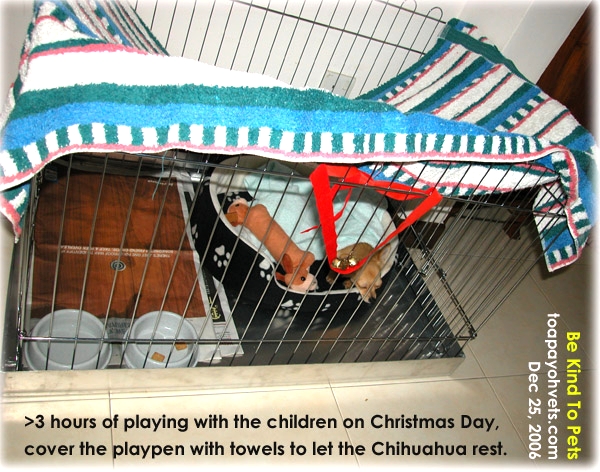
In such cases, cover the crate with towels or bring the
crate to your bedroom. Ignoring the whining and barking
from the first night is also an ignorant habit of the
first-timer.
If you hear past-midnight barking at 2 - 4 am, it
may be the puppy telling you to change his soiled
papers or remove his poop. Some owners get up and
spank or shout at the puppy to shut up!
The tone of barking to change soiled papers is different
from the barking for attention, according to some puppy
owners during my survery.
I must apologise
that I may not be able to discuss in detail with some of
you as it takes at over 30 minutes just to talk about your
puppy toilet training if we have time.
So, I put up a brief report in this website for those of
you who want more information. The 3 research blogs with
over 600 cases (See References Below) are not edited. They
may be overloaded with too much information. I try to get
a book out giving Singapore first-time puppy owners the
overall picture and success in toilet training puppies as
soon as possible.
If you have any
questions, e-mail to me at
judy@toapayohvets.com and I will reply to you as best
as I can. Your questions may be included in the book to
benefit all puppy owners.
SHARING INSIGHTS If you have a meaningful story that you would like to
share, you may help many people with new puppies. Please
e-mail
judy@toapayohvets.com your important insights or
meaningful stories. Remember the basics:
confinement, watch for signs of elimination if you take
the puppy out to play, give firm commands like "Pee Here",
praise and give food treats for good performance,
persevere, no distraction for the first 2-4 weeks, change
soiled papers frequently.
Nipping is a big problem for first-timers.
Discourage nipping and biting by holding the puppy's
muzzle with your fingers curled around the muzzle and say
"No biting" very firmly when the puppy starts mouthing.
Children tend to scream and run, exciting the puppy.
Ask the children (and first-time puppy-owning adults) not
to behave like a prey as the puppy's instinct is to chase
and nip.
Best wishes
Dr Sing Kong Yuen
EQUIPMENT, TOOLS AND
METHODS TO
CONFINE THE PUPPY/DOG
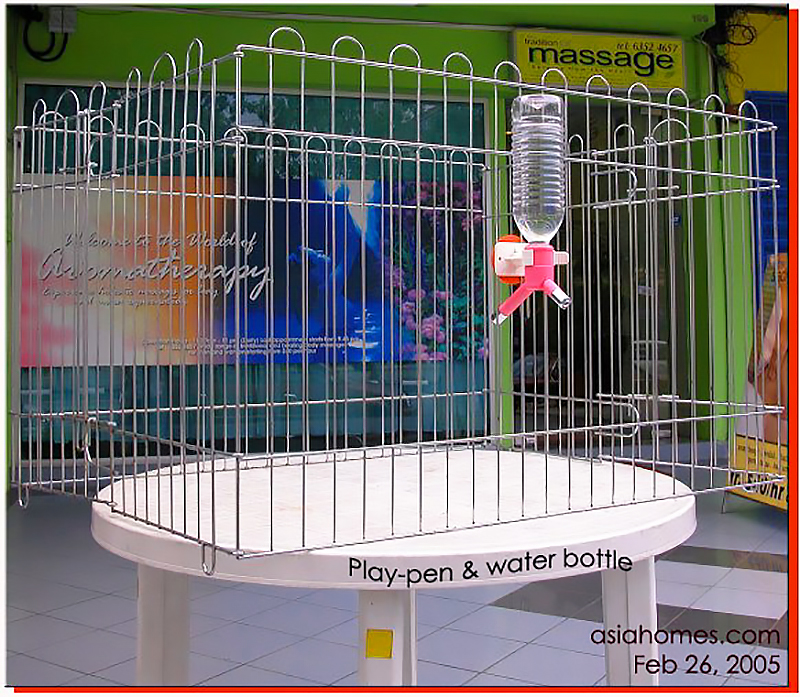
1. PLAYPEN WITHOUT DOOR/PEE PAN
PLAY PEN WITH 4 PANELS.
Most new puppy owners will be sold the play pen. Least
expensive. Around $40. Fences collapse onto the puppy when
the owner is at work depending on the quality.
PLAY PEN WITH 6 PANELS. For big breeds like Golden Retrievers. A playpen is also
known as an exercise pen. Some puppies know how to climb
out or shift the playpen, soiling the floor.
Use bricks or anchor the playpen to a window grille to
prevent shifting or collapse of the panels.
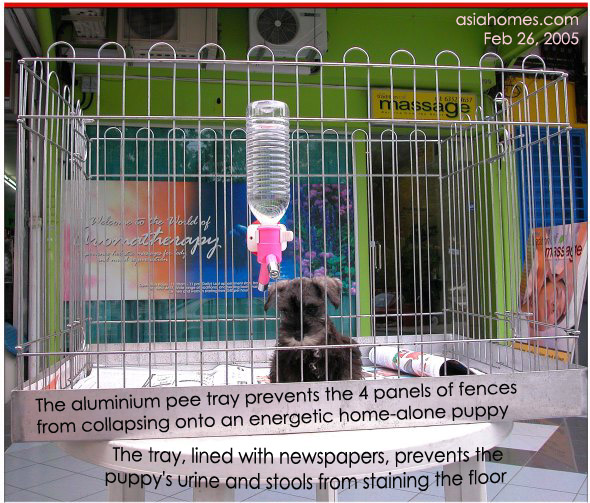
1. PLAYPEN WITH PEE
PAN
A playpen with an
aluminum pee pan preventing the collapse of the fences
onto the active puppy.
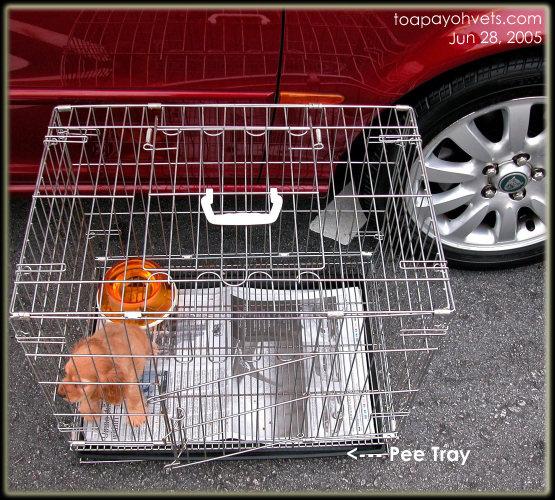
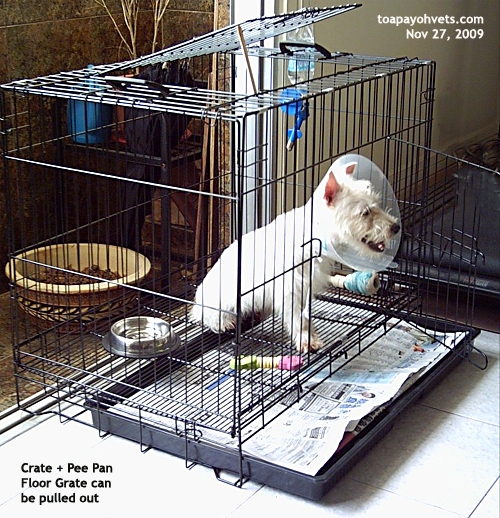
2. CRATE + PEE
PAN. Crate + pee pan
is the 2nd most common equipment sold by Singapore pet
shops, after the Playpen to confine the new puppy.
Wire crate + Pee Pan
is used to confine the puppy at night only.
For Yorkshire Terriers and Chihuahuas, a ramp is needed as
this crate has a higher floor level. Pee Pan may rust.
A luxury stainless steel cage of 3 feet x 2 feet with a
pull-out pee tray. Note the paper shredding which is a
common complaint of puppy owners.
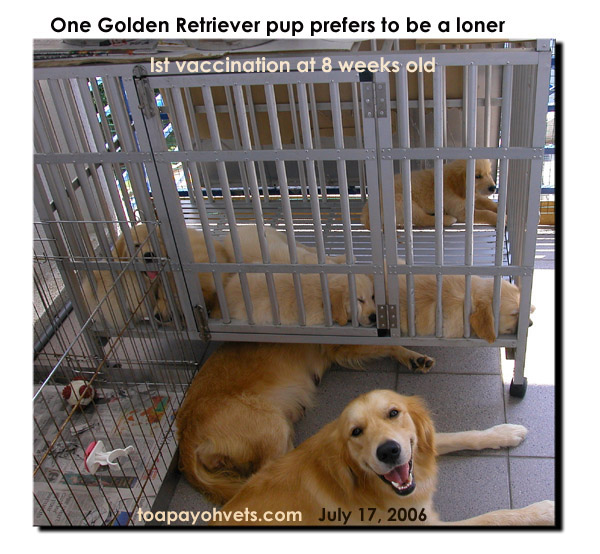
Each pup is different in temperament.
The school Principal had an anti-social Golden Retriever.
The pup was born nearly dead. He was revived and bottled
fed by the Principal. So he related to the Principal as
his "mother" rather than the other canine members.
That is why he did not bother to socialise with his pack
when I first went to vaccinate him in his home. Later on,
he was happy to be with his canine family.
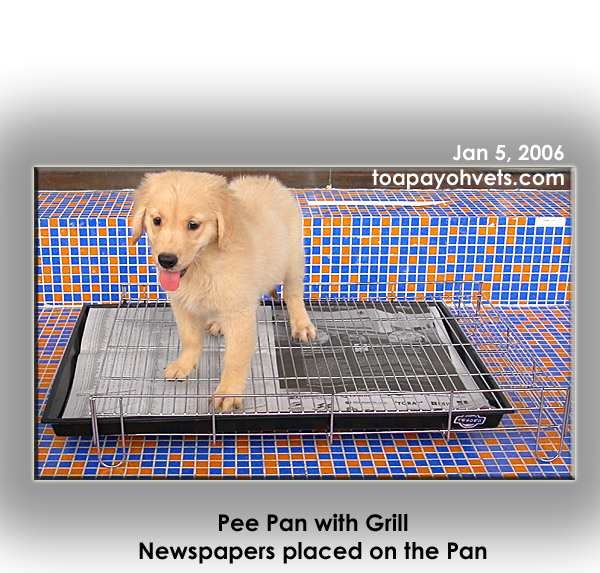
3. GRATE + PEE PAN
WILL RUST. Place the puppy on this
wire flooring when it needs to eliminate. Put
newspapers on the pee pan and spray urine drops or
commercial toilet training aid on the newspapers.
You still need to train the puppy and confine
it to a room or small space to succeed. It takes
about 2 weeks or less if you do full-time training using
the positive reinforcement method.
Pet shop puppies are more receptive to this method.
You can see that the Pee Pan is a bit too small for this
big breed!
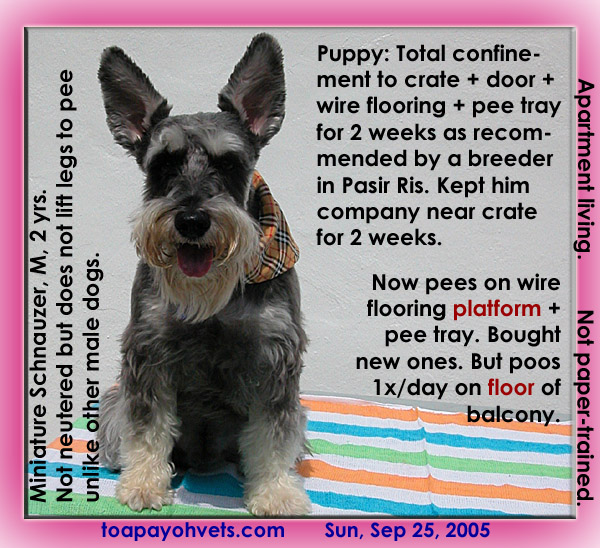
This Schnauzer uses
the Grate + Pee Pan to pee even as an adult. He
poops on the balcony floor. Probably he did not have
much space on the grating. Very much loved by the
whole family. The family was advised to buy a new
grating as the old one had rusted. It was great to see him
grown up.
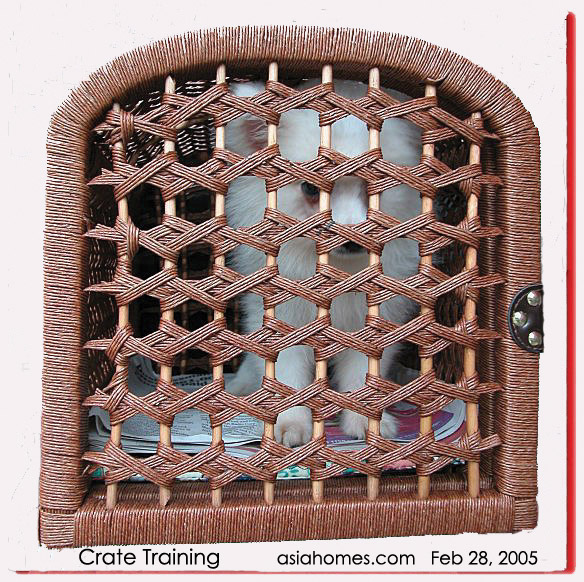
4. CRATE TRAINING
A method of
toilet-training. The puppy is kept inside the crate
with sufficient space to stand and move around.
Initially, every
hour on the hour, increasing to longer periods of time,
bring him out to pee and then put inside the crate.
Use the N-1 formula where N=number of months. However,
this is NOT a scientific fool-proof formula.
As a guide, a 3 month-old puppy can be crated for 2
hours. Start with 1 or 2 hours first. Puppies should
not be confined in a small crate for over 4 - 6 hours.
This method is very successful if you have a full-time
homemaker or maid to do it properly.
5. TETHER
METHOD
The puppy is leashed
around 6 feet to a chair or person so that it can't
wander everywhere to soil the apartment. A balcony may be
the confined area. This tether method is quite
successful in paper-training as the owner has no time to
supervise the puppy.
For Siberian Huskies, the leash may need to be
chew-proof. Such leashes are available at some pet
shops.
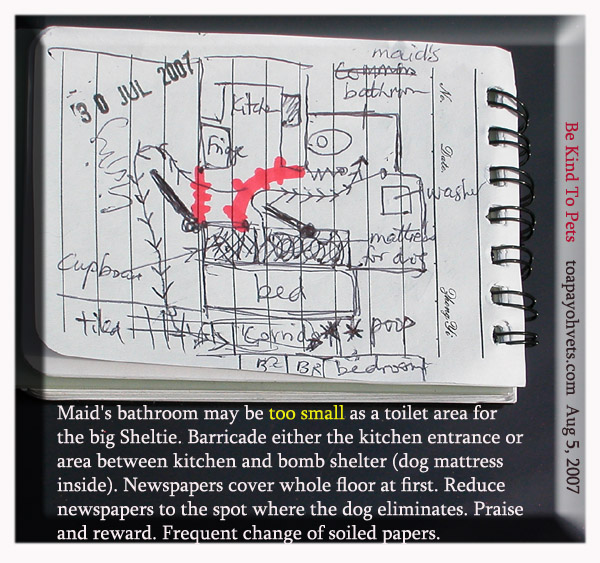
6. ROOM CONFINEMENT
Usually the balcony or
bathroom is used to confine the puppy. Newspapers, pee
pan, crates, grate + pee pan are placed inside the room
for 2-4 weeks. The baby-gate at the door permits the puppy
to see the owners but not come out.
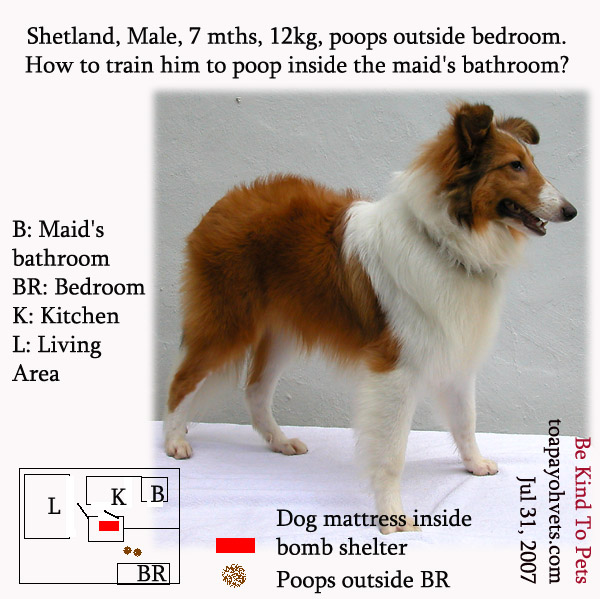
Confine inside
kitchen/maid's bathroom area.
Big breeds may need to be toilet-trained inside the
bathroom or balcony as they pee and poop in larger
amounts.
Outdoor elimination will be preferred.
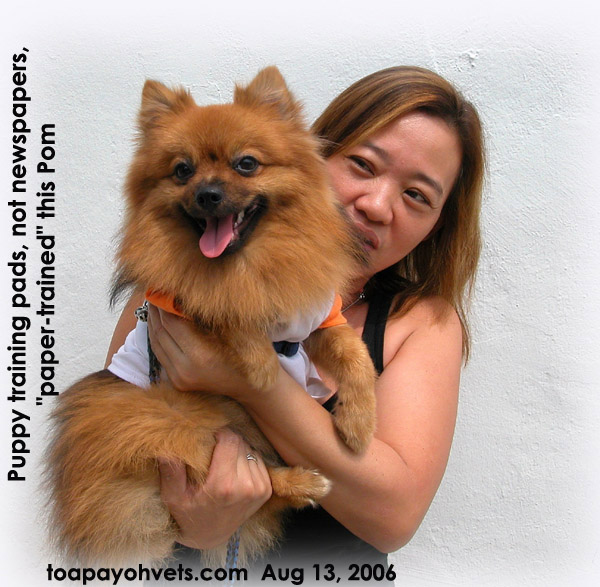
One owner shared
with me her house-breaking training. I followed up
with her after one year during the annual vaccination.
The surprise was that the Pom preferred the "puppy
training pads" or "diapers" rather than newspapers.
Follow up 1 year later. The Pom was successfully "diaper"
trained.
If you let the puppy
out to play for an hour during the first 2-4 weeks of
toilet training, watch for signs of elimination.
Sniffing and turning may be signs that the puppy is going
to pee or poop. Quickly and quietly carry the puppy to the
newspapers or toilet area and say: "Pee here".
You need to be observant as some Singapore owners complain
that the puppy is too fast for them! Have you been
"out-gunned" by your puppy?
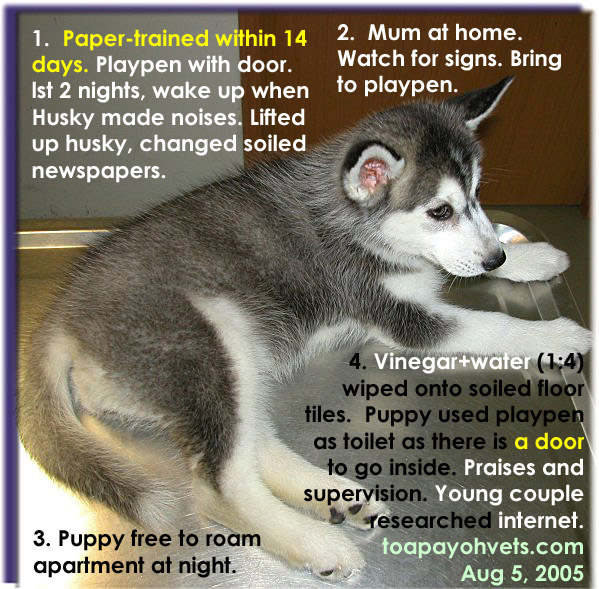
MOST PLAYPENS SOLD
IN SINGAPORE'S PET SHOPS HAVE NO DOORS.
3-month-old Siberian Husky at 3rd vaccination.Successfully paper trained in a playpen with door
in an apartment. This puppy goes to the playpen
(newspapers on cardboard) in the living area next to the
kitchen to eliminate and is free to wander around the
apartment.
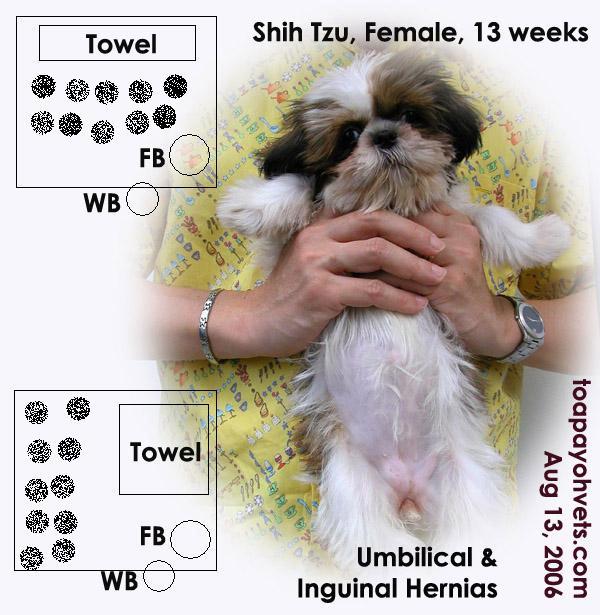
INCORRECT POSITION
OF BEDDING. Many Singapore puppy owners position the feed bowl in
the front and the towel bed at the back of the crate. The
poor puppy has to step on its stools and urine just to go
to its bed or water bowl/bottle.
CONCLUSION.
Spend time toilet-training your new puppy.
If anything happens to you and you are forced to give up
your dog, a well trained dog is easier to get adopted.
Many small breed and pedigree puppies cannot adapt to
community living at NANAS which is mainly a non-kill
animal shelter and they may not be accepted. In animal shelters
all over the world, most puppies are put to sleep after
3 days as there is insufficient kennel space for them.
Therefore, toilet-train your new puppy well and if things
in life do not turn up well for us, our dogs should be
able to get a new home as they are so clean and pose no
problems to the new owners.
Toa
Payoh Vets Clinical Research DR SING'S DRAFT REFERENCES & RESEARCH INTERVIEWS FROM
2005 - 2009.
TOILET-TRAINING OF SINGAPORE PUPPIES
 Toa
Payoh Vets Clinical Research
Toa
Payoh Vets Clinical Research