tpvets_logo.jpg (2726 bytes)

TOA PAYOH VETS -
Pet owner's education - BAD BREATH
toapayohvets.com
Focus:
 Small animals - dogs, cats, hamsters, rabbits. 
                                                                                                                           Date:   25 July, 2005  

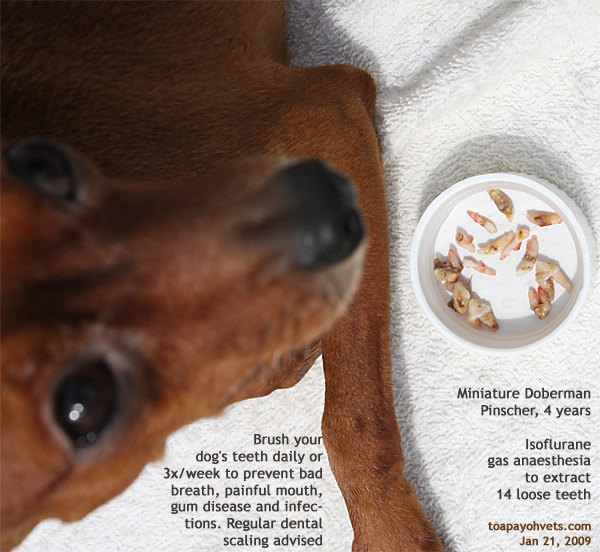
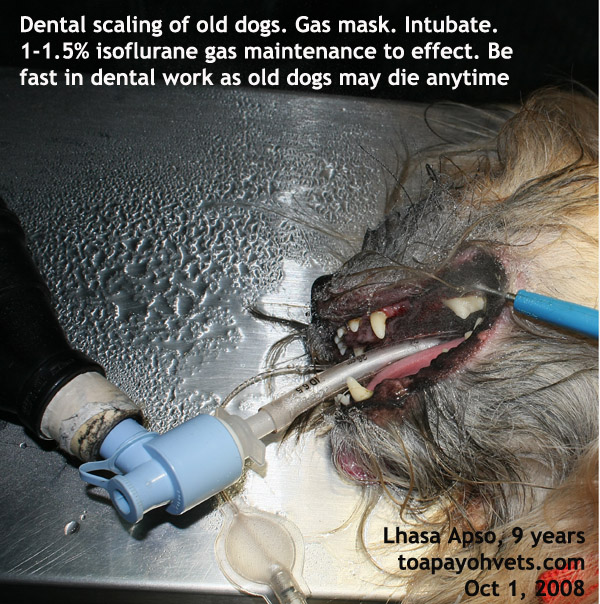
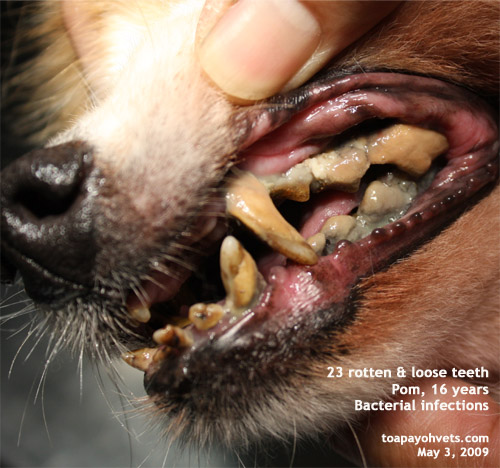
Periodontal disease (bacterial infection of the gums) is the most common infectious disease in dogs and cats. Bad breath is the common complaint but most time-pressed owners don't have time to get their pets treated by the veterinarian. The bacteria multiply and spread via the blood stream to the hart, liver and kidneys.  If there is no regular dental care, more bacteria germs are produced and the internal organs can be severely damaged, shortening the life of your pets and giving them painful tooth-aches (not eating properly).

Periodontal Disease
You don't need to live with bad breath in your dog or cat.
Get a yearly dental check up for your best friend.

0520602Singapore old cat tooth decay, gingivitis, periodontitis, pet health and welfare educational for animal lovers, excerpts from Be Kind To Pets, sponsored by AsiaHomes Internet. Written in Jun 30, 2002.

The cat with the loose tongue


"This stray cat's tongue has been hanging out the front of mouth for the past few weeks. What's wrong with him, doc?" asked Ms Chow who was concerned as she fed it regularly downstairs after her office work at the government ministry in charge of  problem teenagers who "stray" after schools, the latch-key kids of Singapore.  These kids have no purpose in life and mix with bad company, Ms Chow had told me. Staring at each other could provoke a fight between the teen gangs.

It is an unusual habit for any normal cat.  Cats like to keep very clean and don't hang out tongues.  Was its tongue paralysed after another cat battle in the hawker centre to establish its territory?  This was a six-year-old male cat and would have been wise to the battles for ground and female cats.

A half-inch pink tip would be seen hanging from his lips.  He had no appetite and objected strongly when I inserted the thermometer into his rectum to check whether he had a fever. He just swiped his claws into my right hand in less than a blink of the eye.   I got a 10-cm scratch for not being lightning fast enough.

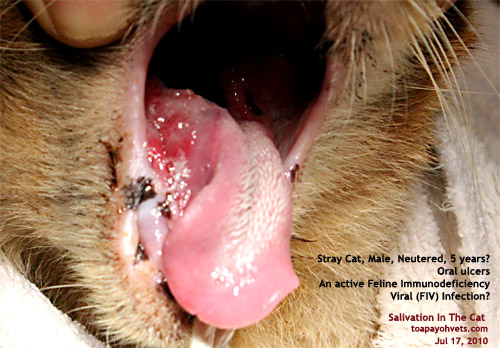
"It may be having mouth ulcers or a severe tooth ache on one side" I said.   The tip of the tongue hung more to the right side, as if there was acute pain on the left side.  The cat's mouth dripped saliva in thick serous streaks and there was a strong rotting smell of bad breadth.  

"You don't expect the cat to answer your question, doc?" asked Ms Chow.

The cat clawed me again when I tried to open his mouth with my thumb and forefinger of the right hand.  No nonsense from any veterinarian, his brown eyes with pupils dilated widely, looked straight at me.

"Don't grip his front feet tightly as cats don't like it and get angrier!" I advised Ms Chow who was firmly restraining the cat.  I didn't want Ms Chow to get her face scratched as that might affect her marriage prospects. Beauty may be skin deep but a scratched face for a young woman will disadvantage her no matter what the feminists say.  

"I have no choice but to tranquilise him with one injection into his back muscle." I told Ms Chow. The cat did not attack her as she distracted him with a few words.  

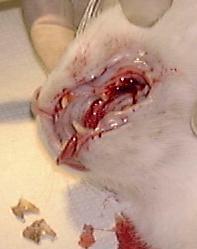
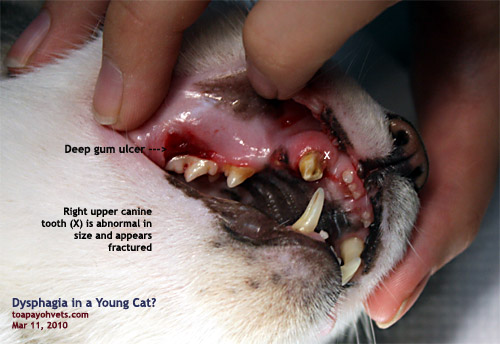
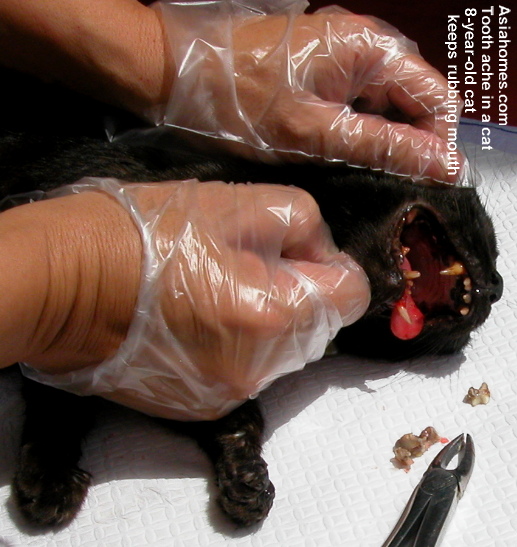
The cat felt drowsy in 10 minutes.  I put him on a gas general anaesthesia to check for more decayed teeth.  Two loose and decayed upper left molar teeth were extracted easily within 2 seconds.  The redness around the molars indicated that the gums were infected with germs which undermine the integrity of the tissue and causing gingivitis (infected gums). 
Singapore 6 year old stray cat: 2 decayed molars extractedNormal molar teeth of six-year-old cats have three deep roots which anchor them into the gum tissues firmly and cannot be extracted so easily.  The roots were decayed as you could see them on the lower left of the picture.  The lower molars of the left gums were enveloped with a thick crust of tartar but were still strongly anchored into the lower jaw.  The tartar was removed and all the teeth were given a ultra sonic scaling.

There were no mouth ulcers or gum tumours. The tongue no long hung out.  I don't expect to see this stray cat again as he will not get any annual veterinary check up or booster vaccination, being a street cat with the freedom to roam the void decks of the Housing and Development Board precincts and the street smartness to avoid being trapped by the government cat catchers.    


Note:

Teeth problems in the domestic cat are due to genetics and the diet, amongst other factors. 

In the wild, cats e.g tigers or leopards feed on real meat which cleans their teeth as they chew.

Some domestic cats fed soft food can suffer from severe gum and teeth problems caused by various factors including inherited weaknesses.

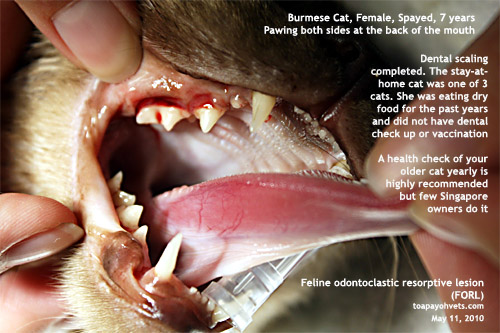
Cats, usually over 6 years old, suffer from 2 major degenerative oral problems: periodontal diseases (gum diseases) and resorption cavities.  

In gum diseases, the necrotic mouth ulcers and bad breadth are due to bacterial infection of the mouth. If the bacteria reaches the back of the throat, the cat may lose its meowing voice and has a bad breadth. Antibiotics and teeth scaling may stop the bad smell of purulent stomatitis (mouth inflammation) but there is a need to extract the decayed back teeth.  Cats need to have their diet modified if they don't have back teeth but they manage well.

In cervical resorption, there are cavities (holes) on the surfaces of the back teeth, close to the gum margins. They are not decay cavities but are caused by an auto-immune response.  The cat's body's defences destroy the teeth. The cat may lose appetite as it is very painful. Teeth extraction is the best treatment.     

Reference: 

A Colour Atlas of Veterinary Dentistry and Oral Surgery" by Peter Kertesz.  Peter is a dental surgeon for people and is a dental consultant for animal organisations and international zoos including London and Whipsnade zoos for the past 20 years.  He lectures all over the world on veterinary dentistry. When it comes to treating animals, Peter has strong ethics.  He never performs surgery to please the owner and only treats pets that have been referred to him by a vet. 
Periodontal Disease
You don't need to live with bad breath in your dog or cat.
Get a yearly dental check up for your best friend.
050721Singapore old dog tooth decay, gingivitis, periodontitis, pet health and welfare educational for animal lovers, excerpts from Be Kind To Pets, sponsored by AsiaHomes Internet. Written in Jun 18, 2005.

TWO DAYS TO LIVE
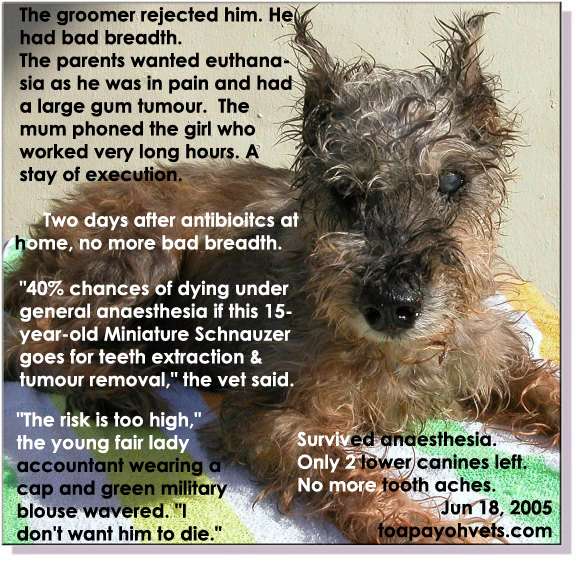
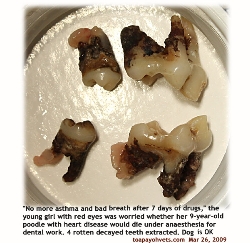
"40% chances of dying under general anaesthesia," I estimated the risk when the young lady owner asked about her 15-year-old Miniature Schnauzer's dental treatment which required general anaesthesia.

I had vaccinated this dog as a puppy when the young lady was still in secondary school. Teeth braces to straighten her teeth. Full of ideals. Now, she is a beauty. Maybe, she will be a pillar of society in time to come as she climbs the corporate ladder single-mindedly.  

"The risk is too high," the lady adjusted her cap and smoothened the wrinkles on the sleeves of her camouflage blouse. Wearing caps seem to be a fashion amongst the young in 2005. Also, exposed mid-riffs in women but she was dressed conservatively. 

Now, her parents had given her an ultimatum. Mum told me that the father had given her one day to decide after I had deferred euthanasia.

The old dog had just 2 days of antibiotics when I advised 10 days on antibiotics before dental extraction to give this dog a better chance of survival after the treatment. Antibioitcs would get rid of the foul smelling bacteria in the mouth.  But there was no such luxury of time.  He just had two days to live.

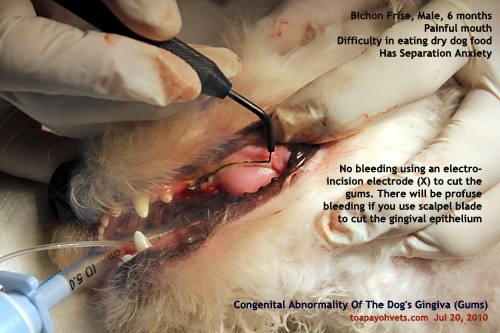
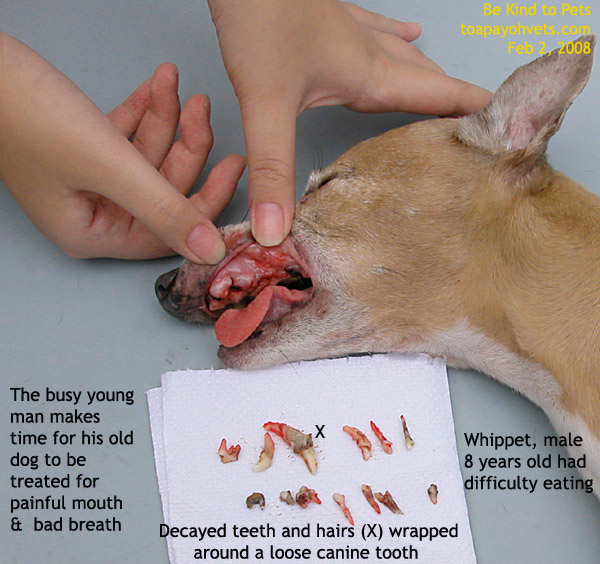
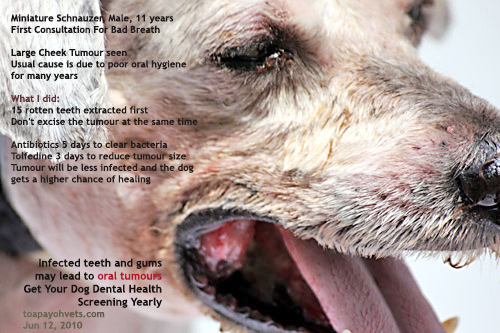
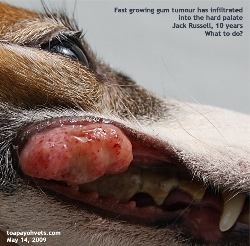
The parents felt that he had too much suffering. He had a bleeding mouth, bad breadth, difficulty in eating and a 10-cm circular gum tumour behind his upper front teeth, on the hard palate.  Mouth tumours usually occur if a dog had bad oral health.  Sometimes, the gum tissue enlarge and you can see thick pink lumps. This condition is called hyperplastic gingivitis and is common in some breeds.

2-yearly dental examination for older dogs best. Toa Payoh Vets
 
tpvets_logo.jpg (2726 bytes)Be Kind to Pets - Educational picture No. 272. Jun 18, 2005.
A young lady's dilemma. Let the parents euthanase an old friend when she's working or risk him dying on theperating table?  The vet had to decide for her as there were strong parental preference for euthanasia to relieve his suffering.  

Even the dog groomer refused to groom him, the mother told me. Was the bad breadth so revolting? Making the groomer wanting to puke?

The only two persons who did not want him to be put to sleep was this young lady and me. I had seen him as a puppy and though I did not see him for the past decade, I did not want to euthanase him.

He was like a long-lost friend to me whom you meet once in a blue moon. He could not talk but there were the fond memories of his younger days.

The mum reminded me, "Remember him? You cropped his ears."  That was 15 years ago. Cosmetic surgery was permitted in Singapore. Now, I no longer crop any dog ears.

The young lady had a Hobson's choice. If she did not proceed with the dental treatment, the dog would be put to sleep on instructions of her parents. They could go to another veterinarian if I refused to do it.

Two days to live. I would take the parents seriously. The old dog was suffering. His quality of life was poor. They were kind enough to tolerate the bad breadth for so many years.  Their daughter was seldom at home as she worked very long hours.

Yet, a little thing like dental extraction of decayed teeth and the removal of his tumour would give him a much better quality of life.

The young lady wavered. No euthanasia if she was around. Yet the old friend might die on the operating table. I was surprised that he lived up to 15 years old. Trim. Two full cataracts whitened his eyes if you looked at him directly. He was 90% blind.

"You don't really have much choices," I explained to the young lady. "Your parents could perform a coup de grace on this dog while you are working."

She understood what I meant about her parental pressures and her lack of time to thwart any moves for euthanasia.

She was extremely busy in her profession. A profession she loved as she dedicated long hours to honing her skills and expertise in financial statements.  

Her parents had decided on euthanasia.  Somehow they agreed to 2 days' stay of execution after consulting me.

"If you euthanase this dog and present to your daughter with a fait accompli," I did advise the parents, "She may never speak to you forever. Young adults nowadays are kinder to their pets and would rather save them (unlike the baby boomer generation who are thrifty-minded)."

That advice gave the old dog 2 days' reprieve and that was why I saw this young lady and her mum today. The father had ordered a 1 day's stay of execution, her mum told me.   

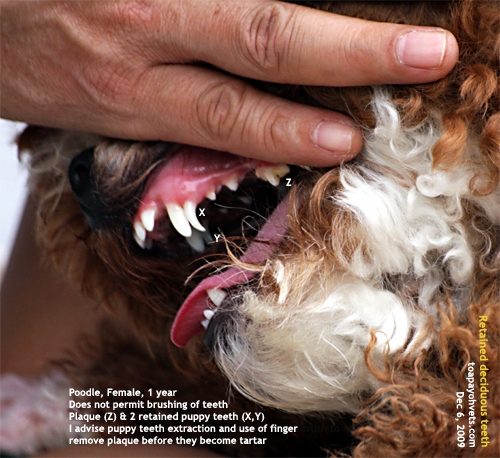
Now, the mouth bleeding had ceased.  The bad breadth had gone.  If only this dog had regular yearly dental check ups, he would still have good teeth and no bad breadth.   

Would the young lady take the risk? A professional who is trained to understand that 40% chances of dying is a very high risk. I mean, if there is 40% of losing your money in an investment, she would have had advised against investing.

But we are talking about death. Death is final and today is judgment day.

She hesitated. A little girl with dangling arms and free spirits had to make a life and death decision. 

A lady with porcelain fair complexion not damaged by the tropical sunlight was no more a little girl to others, but would always be one to me and her parents.

What decision would she make today?

"Dogs do die on the operating table for various reasons. There are dogs in similar situations with much lower percentage of survival," I explained. "40% is extremely high for this healthy 15-year-old." 

That means 60% of similar cases will die. You can either judge a glass as 60% empty or 40% full of water.

Be pessimistic or optimistic. See the risks of death or the opportunities of enjoying a higher quality of life with this old companion.

I wanted to leave her alone to decide. But there was strong parental pressures to end this dog's life as it was suffering. And had been suffering for a long time. "You are not at home most of the time," Mum had admonished her. "But it is the domestic worker who looks after him," the young adult retorted.

This time, would the young lady make a risky decision as only she could?  It was a matter of life or death.

"Get the dental treatment," I advised. She nodded her head and left without a word. 15 years of friendship would vaporise if the dog died on the operating table today. That would be the last time she would see him alive if things go wrong.       

The dog was put under gas anaesthesia. No tranquiliser.  The few decayed teeth were extracted. Only two canine teeth were strong and good.

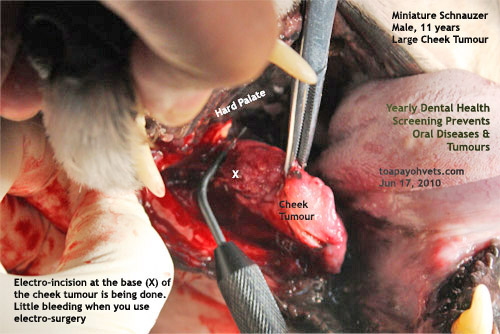
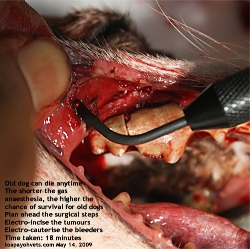
Lots of bleeding. The hard palate tumour was removed. More bleeding from the gums and nostrils. The bleeding was not life-threatening but could be inhaled into the lungs causing pneumonia. 

The dog woke up almost immediately after the dental treatment. He was in good health as other senior dogs would have taken a longer time to wake up.

I hope he lives up to 20 years old. I doubt I will ever see him again. Just as I had not seen him for the past decade. Had he been to another veterinarian, this dog would have been put to sleep. That would have been the usual advice. Sound advice but not entirely satisfactory for this lady owner. For some reason, the parents came to me. 

All ended well but a happy ending in all dental treatment of old dogs is not guaranteed.  All veterinarians will suffer from some deaths in such cases and these are distressing to both parties.

For this young lady, there is now a close friend to come home to after the long hours at the office. After a hard day's work, the best friend to come home to.  He was the one who waited for the young lady to return home after long hours of work. I hope he would live his life for a few more good years and make her happy. 


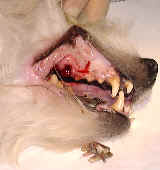
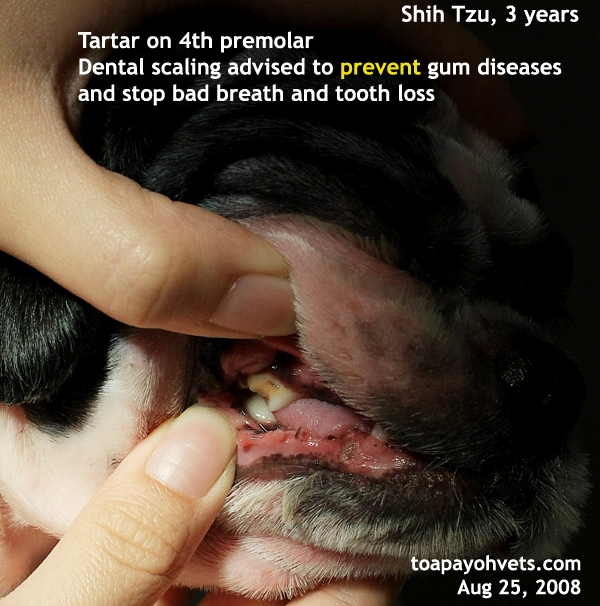
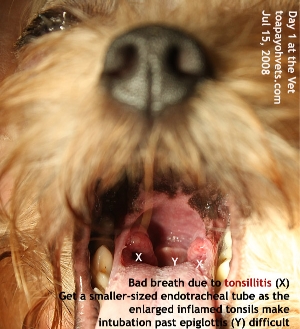
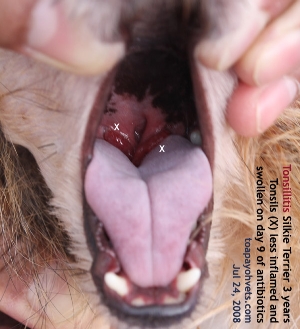
Early prevention of tooth decay by regular dental scaling. Toa Payoh Vets Silkie with periodontal (gum) disease and bad breadth. Dental scaling. Toa Payoh Vets.
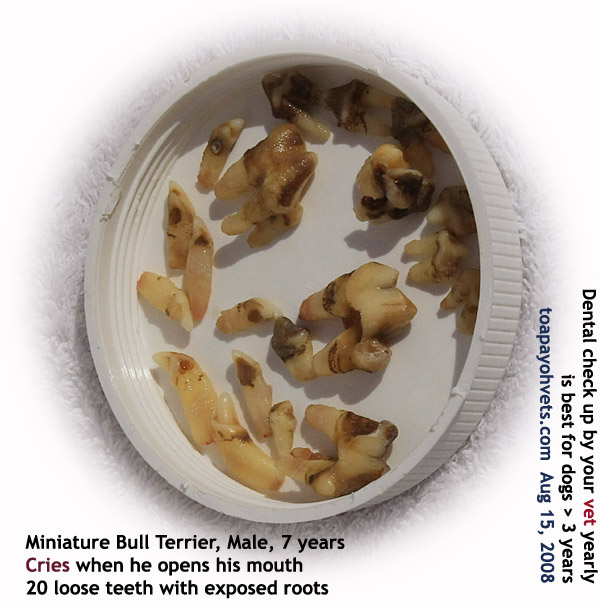
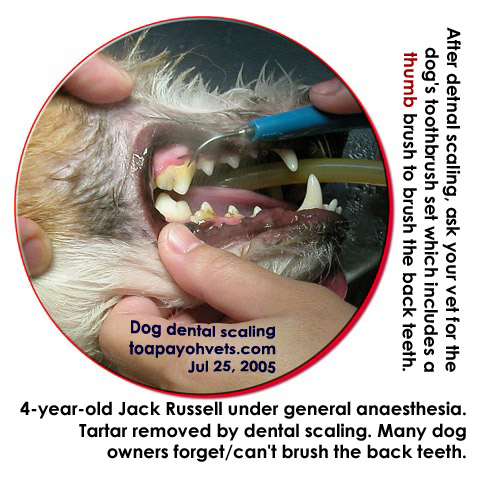
tpvets_logo.jpg (2726 bytes)296. Ju1 22, 2005.  Regular dental scaling means that the dog's teeth will last for more than 10 years. A thumb toothbrush may be useful if your dog dislikes the dog's toothbrush for the back teeth. Ask your vet.   tpvets_logo.jpg (2726 bytes)The back teeth gets more plaques as the dog grows older, as in this Silkie Terrier. It is better late than never to do dental scaling. If there is further delay, the back teeth decay and the teeth just drop off. The dog just can't tell you he is having daily tooth aches.  You can tolerate his bad breadth but he is suffering from pain.
LINKS: 

Educational articles: 
The cat has 7 lives


Brushing dog's teeth with electric toothbrushes.


asiahomes.com
sinpets.com
Be Kind To Pets
   

toapayohvets.com
Copyright
© Asiahomes Internet
All rights reserved. Revised: July 25, 2005